

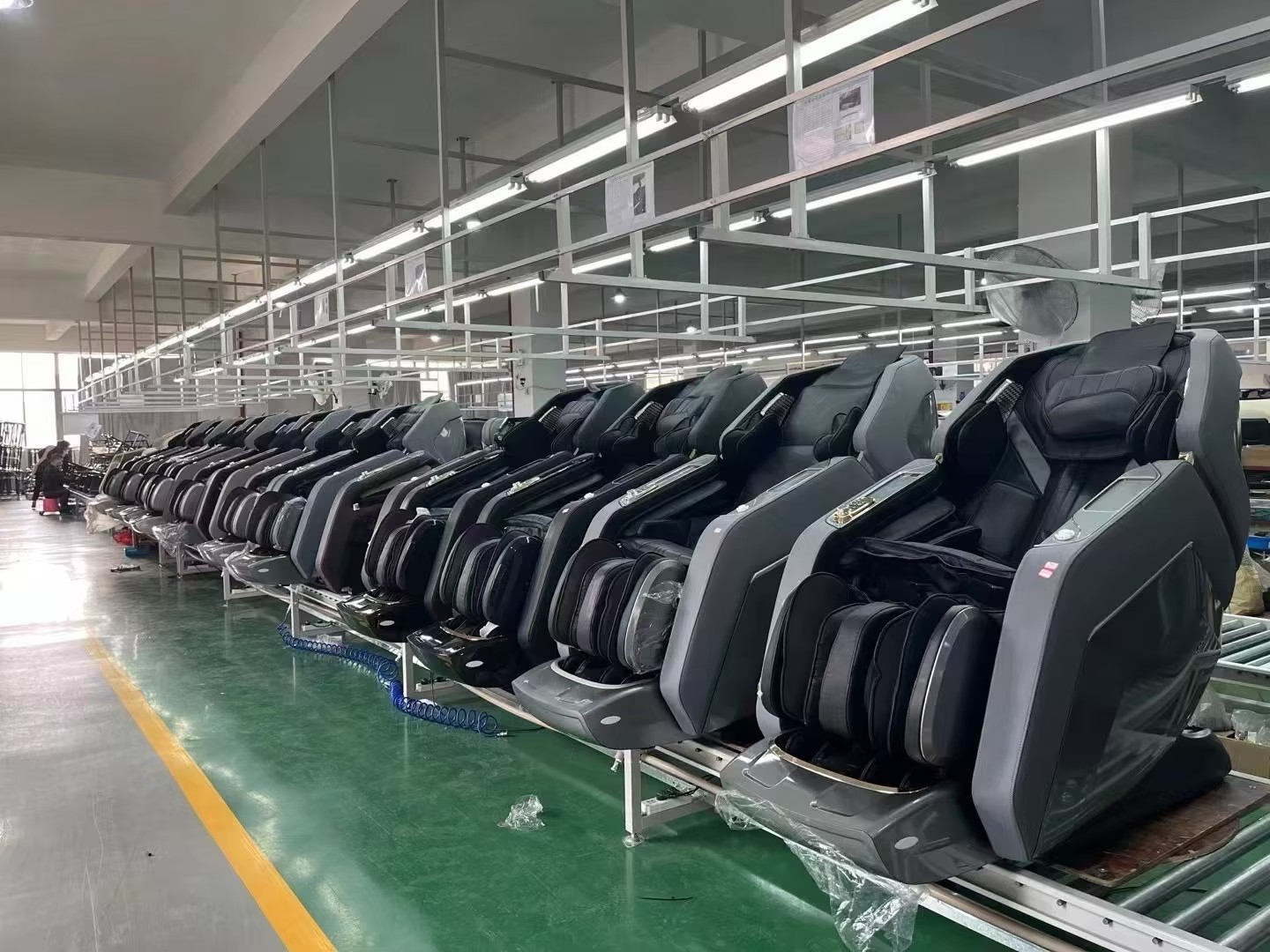
Molink Tech factory – massage chairs moving through assembly and testing.
Every massage chair brand starts with the same question: which mechanism should my model use? The answer drives price positioning, feature claims, and the experience your end customer remembers.
Mechanism selection significantly influences massage depth, coverage, noise, durability, and perceived quality. But like any complex manufactured product, a massage chair cannot be judged on the mechanism alone. Frame structure, track type and length, motor quality, control electronics, upholstery, airbag system, and final assembly discipline all shape the finished product. When buyers experience weak massage, noise, or short product life, the mechanism should not be the automatic scapegoat – the whole system must be evaluated.
This guide explains how to define your requirements first, compare mechanism families against those requirements, and validate your choice with whole-chair testing before you commit to an OEM program.
Is the Mechanism Really Causing the Problem?
When a returned unit feels weak, noisy, or unreliable, start by identifying when and where the problem appears.
- If a chair performs well in early testing but develops noise, skipped strokes, or inconsistent pressure after weeks of use, investigate motor quality, roller material wear, track tolerances, lubrication, and the control board’s current handling – not just the mechanism type.
- If the problem appears immediately – weak pressure, uneven roller contact, or jamming at a specific body size – check frame alignment, track profile, gearbox assembly, harness/controller parameters, and whether the roller path actually fits the intended body range.
A useful first-stage diagnosis is:
| Observed Issue | Mechanism-Related Factors | System/Process Factors to Check |
|---|---|---|
| Weak or uneven massage pressure | Roller type (fixed vs 3D/4D), protrusion depth, motor torque | Frame alignment, harness calibration, upholstery padding thickness |
| Audible noise during movement | Gearbox quality, roller material, track smoothness | Screw torque, lubrication, wire routing, panel resonance |
| Limited back/leg coverage | Track type and length (L-track vs SL-track), roller travel | Frame geometry, harness limits, seat recline angles |
| Inconsistent performance after aging | Motor durability, plastic gear wear | Thermal management, power supply stability, QC sampling |
| Jamming or stalling on larger bodies | Roller reach and extension range | Track tolerance, load capacity, speed settings |
Define the Performance Requirements First
Before comparing mechanism families, define what your target market actually needs. A useful specification should include at least:
- Target price band and market positioning – entry-level promotion vs premium flagship;
- Massage style and intensity – fixed roller, 2D, 3D, or 4D motion, and required intensity levels;
- Body coverage – back-only (L-track) or back plus glute/thigh extension (SL-track);
- Body-size adaptability – body scan, adjustable width, roller protrusion control;
- Noise limits – acceptable sound level in a home or commercial environment;
- Usage intensity and expected life – home use vs showroom/commercial use;
- Safety and compliance targets – CE, RoHS, FCC, and destination-market requirements.
Only after these targets are defined can mechanism families be compared against your application rather than against marketing labels.
Compare Mechanisms for Your Massage Chair Program
There is no single “best” mechanism for every massage chair. Different families emphasize different performance characteristics.
Massage Chair Mechanism Selection Guide
| Mechanism | Primary Performance Focus | Typical Positioning | Key Evaluation Parameters |
|---|---|---|---|
| Fixed / 2D rollers | Simple up-and-down and back-and-forth massage | Entry-level chairs | Noise, coverage, consistency, cost |
| 3D rollers | Depth-adjustable massage intensity | Mid-range to premium | Protrusion range, pressure control, quietness |
| 4D rollers | Variable speed and rhythm combined with depth control | Premium flagships | Rhythm response, depth precision, software tuning |
| L-track | Back massage along the spine line | Standard models | Coverage length, recline compatibility |
| SL-track | Back-to-glute and thigh continuous coverage | Full-body models | Extended coverage, body-fit, smoothness |
Fixed and 2D Rollers for Balanced Entry-Level Performance
For entry-level models, cost control and reliability usually outweigh feature depth. Fixed-position rollers or simple 2D mechanisms provide consistent up-and-down massage with fewer moving parts, lower noise risk, and simpler quality control. They are a solid starting point when the priority is a dependable product at a competitive price.
3D Rollers for Depth-Controlled Massage
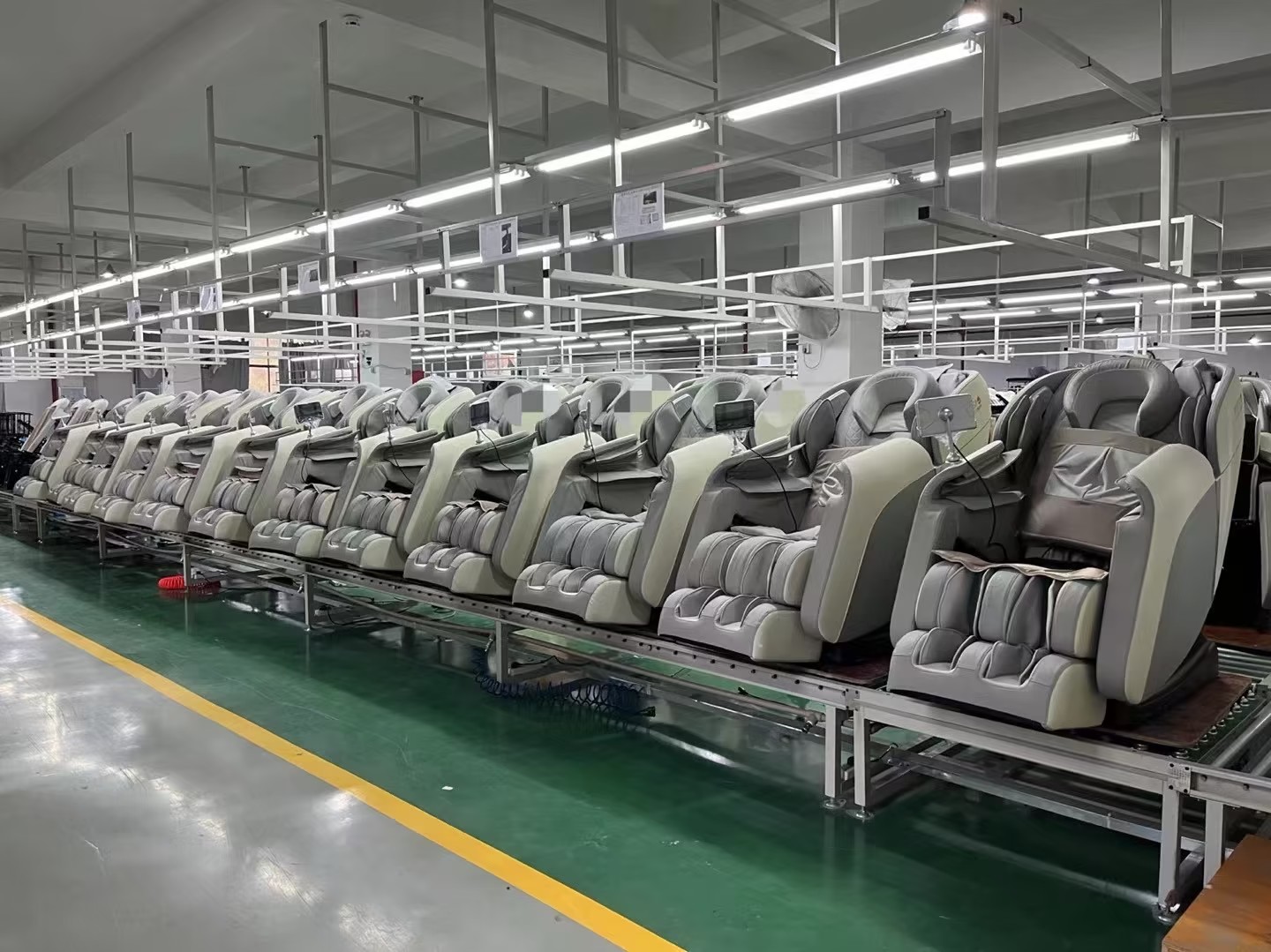
Every unit is tested before shipment – mechanism behavior is verified on the full chair.
3D mechanisms add protrusion control, letting the rollers press deeper or gentler across different body areas. This directly affects perceived massage strength and user comfort. When your market expects adjustable intensity rather than a fixed path, 3D is the mainstream choice – it is why most mid-range and premium massage chairs on the market today are built around 3D or higher systems.
4D Rollers for Premium Rhythm and Depth
4D mechanisms combine depth control with variable speed and rhythm, allowing the massage to imitate a therapist’s changing pace. The value is delivered through precise software tuning as much as hardware. 4D is appropriate when your brand needs a flagship story and the supply chain can support consistent calibration across units. Remember that 4D is an enhancement of the massage experience – it does not by itself guarantee quieter motors, a better frame, or stronger build quality.
L-Track and SL-Track for Coverage Design
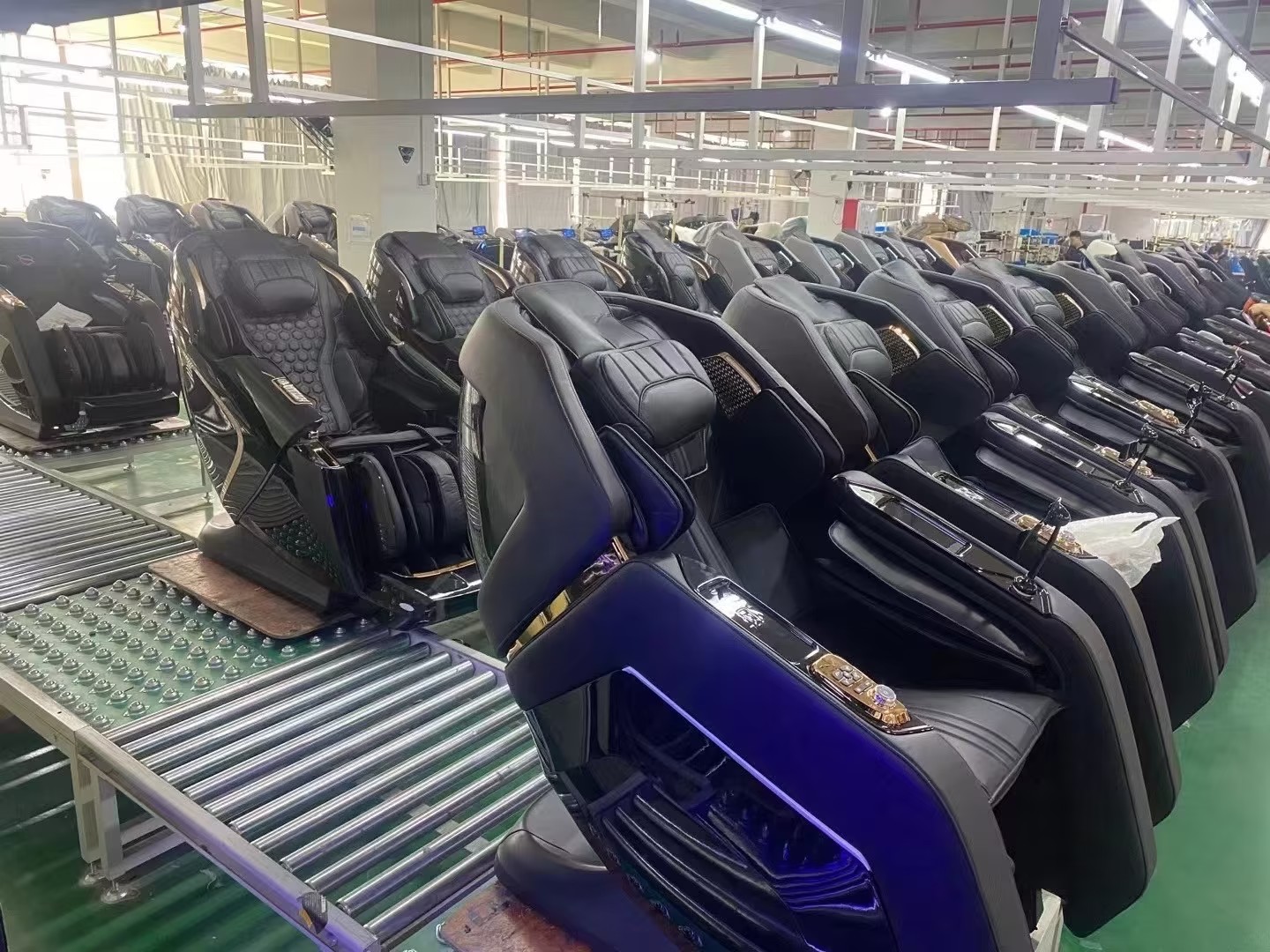
SL-Track coverage is designed and verified on full-body frames in the factory.
The track decides how far the rollers travel. L-track follows the spine along the back. SL-track extends the path down through the glutes and upper thighs for continuous whole-body coverage. SL-track chairs generally cost more but address a common consumer complaint: “the massage stops too early.” If full-body coverage is a core selling point in your target market, SL-track should be shortlisted; if back-focused massage is enough, L-track may be the better cost choice.
A Practical Screening Matrix
| Main Requirement | Candidate to Evaluate |
|---|---|
| Cost-efficient entry model | Fixed or 2D rollers, L-track |
| Adjustable massage depth | 3D rollers |
| Premium flagship experience | 4D rollers + SL-track |
| Full-body continuous coverage | SL-track with extended roller travel |
| Quiet operation as a priority | Evaluate motor and gearbox quality across all families |
This matrix is only a starting point. Frame steel, upholstery, airbag placement, motor selection, electronics, and final assembly quality will all change the result.
Test the Complete Chair, Not Just the Mechanism
Controlled whole-chair trials provide more relevant evidence than comparing specification sheets alone.
When comparing mechanism options:
- Keep the rest of the design consistent – frame, track, control board, power supply, upholstery, and QC process – and change only the mechanism under evaluation.
- Test at defined conditions: repeated cycles, maximum load, continuous operating time, and representative body sizes.
- Measure what your market feels: noise level, pressure consistency, coverage, and comfort across different users.
- Verify aging behavior, not just initial performance: run durability cycles and re-check noise, roller alignment, and function after aging.
- Inspect for secondary issues: excessive heat, odor, cushion deformation, and visible wear.
A chair that performs well in a short demo may behave differently after extended use. Both initial performance and aged performance matter.
Work With Molink Tech on Your Mechanism Evaluation
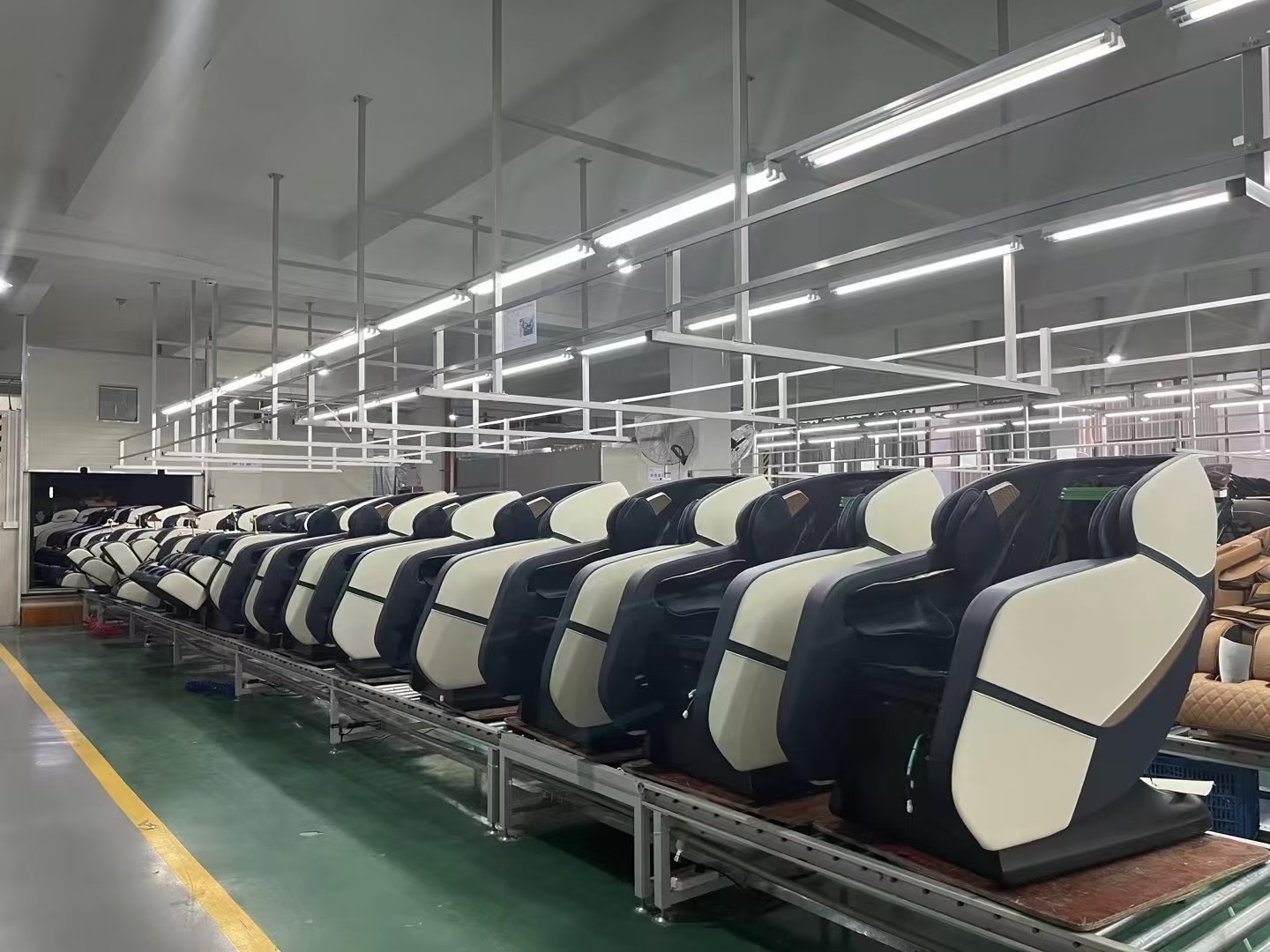
Molink Tech runs complete in-house production lines for OEM and ODM programs.
For an OEM or ODM program, customers can provide information on their target market, price band, required massage style, body coverage, noise limits, usage intensity, and compliance targets. After receiving the RFQ, Molink Tech can confirm any missing parameters and provide available mechanism options, model references, test data, and sample arrangements.
If testing is required, sample quantity, freight, and timing can be confirmed before shipment. Customers can then evaluate the complete chair and share feedback. Based on the results, both parties can proceed with quotation and supply confirmation.
Molink Tech is a massage chair manufacturer in Fu’an City, Fujian Province, China, with over 15 years of team experience, exporting to more than 50 countries. The company operates complete in-house production – frame welding, upholstery, mechanism assembly, electronics, and final inspection – supporting any form of OEM and ODM customized demand.
Conclusion
Mechanism selection can influence massage depth, coverage, noise, durability, and long-term performance of your massage chair program. However, it is only one part of the product. Decision-making starts with defining your market’s performance requirements, then comparing mechanism families against those requirements, and finally validating with comparative whole-chair test data rather than assumptions.
When application-specific requirements are clearly defined, and candidate mechanisms are evaluated against those requirements, product decisions can be based on test evidence instead of marketing labels.
Contact Molink Tech to request mechanism options, model references, or samples for your massage chair OEM trials.
FAQ
Q: Which mechanism is suitable for my massage chair program?
A: There is no universal answer. Fixed or 2D rollers suit cost-driven entry models, 3D rollers are the mainstream choice for adjustable depth, and 4D with SL-track is appropriate for premium flagships. Define your market, price band, and coverage needs first – then confirm with whole-chair evaluation.
Q: Does 4D always mean a better massage chair?
A: No. 4D adds depth and rhythm control, but noise, durability, pressure consistency, and build quality depend on the entire system – motors, track, frame, electronics, and assembly quality. Evaluate the complete chair.
Q: How should I evaluate a mechanism option before ordering?
A: Compare options under the same design conditions, test noise, pressure, and coverage at defined load and running time, then repeat checks after durability cycles. Inspect for heat, odor, and visible wear – and always test aged performance, not just initial demo performance.
Molink Tech – Professional Massage Chair Manufacturer in Fu’an, Fujian, China. OEM and ODM programs for brands, distributors, and importers in more than 50 countries. Contact: famolink@163.com | www.molinkpro.com
One thought on “Massage Chair Mechanisms, 2D to 4D and SL-Track: What Actually Matters for Your Market”