

Seven new models of massage and wellness equipment went live this week, and they do not belong to one story. Two are bought by people who run treatment rooms, two by people who run buildings, two by people who sell to beauty counters, and one by people who move — on warehouse floors and on trails. Sorting them by product type — “massagers”, “beauty devices” — would make the list tidy and the page useless.
So the seven are grouped below by buyer and by room. Each group gets the same four things: who buys it, the constraint that actually decides the purchase, the models inside it, and what to confirm before you order. If you already know which shelf is yours, skip to that group.
Massage, beauty and mobility equipment: how the seven are grouped
| Group | Who buys it | Models | What decides the order |
|---|---|---|---|
| 1. Treatment room | Massage, spa and sports-recovery operators; professional equipment distributors | AS-91, AS-92 | Therapist hours per client, and whether you need demonstration units on a showroom floor |
| 2. Wet room and laundry | Hotel, resort, gym and pool facility procurement; commercial laundry and hotel-supply distributors | AS-97, AS-89 | Power available at the installation point, cycle time, and how many labour hours the unit removes |
| 3. Head and face care | Beauty and skin studios; personal-care, gift and hotel-amenity retail; private-label brands | AS-94, AS-86 | Retail packaging, price point, and how many units fit a shelf or a treatment menu |
| 4. Walking assist | Industrial and facility operations; plus outdoor and mobility retail | AS-85 | Headcount, shift length and how batteries are swapped |
Groups 1 to 3 are wellness lines and share a support model: samples before bulk, private label, a manual in your language. Group 4 is not. It is bought by an operations or safety manager on a headcount calculation, it is issued to a worker rather than placed in a room, and the questions asked about it are about IP rating, battery swap and shift length. Reading group 4 as a wellness product with an industrial photograph is the fastest way to lose that buyer.
Group 1 — Treatment room equipment: AS-91 and AS-92

Who buys this group
Operators of massage and wellness studios, hotel and resort spa floors, sports recovery rooms and physiotherapy practices — plus the distributors who supply them and keep demonstration units in a showroom. The AS-91 is built for that last case as much as for the treatment itself: a distributor uses it on a showroom floor to run a programme in front of a buyer before that buyer commits to fitting a room.
The constraint both models answer
A treatment room has one fixed capacity, and it is the hours of the person working in it. A therapist who performs the whole session serves a limited number of clients a day, and the quality of that session depends on who is on shift. Both units below move part of that hour away from the therapist without moving the client out of the room.
That is the purchase argument, and it is not “more features”. It is: can one operator supervise more sessions, or deliver a more repeatable one, inside the same eight hours.
AS-91 — six-axis robotic massage arm
The arm carries the routine instead of the hand. The head is chosen for the area — finger-press, vacuum-cup or wave-pulse — and the arm follows the same path each time, so two operators produce the same session.
Force is set per programme and capped per programme: the finger-press head runs 15–65 N with a 20 N default, the vacuum-cup and wave-pulse heads 20–150 N with a 40 N default. The ceiling is the part that matters commercially. A programme cannot be overshot on a client who needs a lighter touch, which is the risk that normally stops a clinic from handing pressure to a machine.
- Six-axis arm with programmable path; vacuum 20–80 kPa across 9 levels
- Head heating 30–60 °C across 11 levels
- Tablet control with AI voice input
- Emergency stop, force-deviation detection, over-travel reset and surface overheat protection
- Single-unit carton 820 × 740 × 1345 mm
Where it earns its place: a room that currently sells a signature routine but cannot guarantee the same routine from every therapist, and a distributor who needs one machine to demonstrate several programmes.
Full specification, packing data and product images: Molink AS-91 six-axis robotic massage arm
AS-92 — quad-head percussion massager
This is the opposite purchase: not a fixed installation, but a unit that gets handed around a room. Four silicone heads sit on one plate with a 10,000 mm² contact area, so a single pass covers a wider band of muscle than a one-head gun, and the triangular grip lets the operator work a shoulder or a thigh without changing hands.
- 24 W motor, up to 3,150 strikes per minute
- 20 levels across four zones, plus an auto-frequency (AP) mode that varies the rate instead of holding one speed
- 2,500 mAh battery; 155 mm silicone grip; ABS body
- Red LED ring and an ion output rated around 800,000 per minute
Because it draws 24 W it runs from a normal socket or a portable pack. No dedicated circuit — which matters in a room that was not wired for equipment.
Full specification, packing data and product images: Molink AS-92 quad-head percussion massager
What to confirm before you order this group
- Voltage, plug type and manual language for the destination market.
- The programme list for the AS-91. The arm is only as useful as the routines loaded on it; confirm them at order stage, not after delivery.
- Whether you need a demonstration unit on a showroom floor before committing to stock.
- Carton dimensions and gross weight are confirmed on the packing list issued with each order. We do not estimate them in advance.
Group 2 — Wet room and laundry line: AS-97 and AS-89
Who buys this group
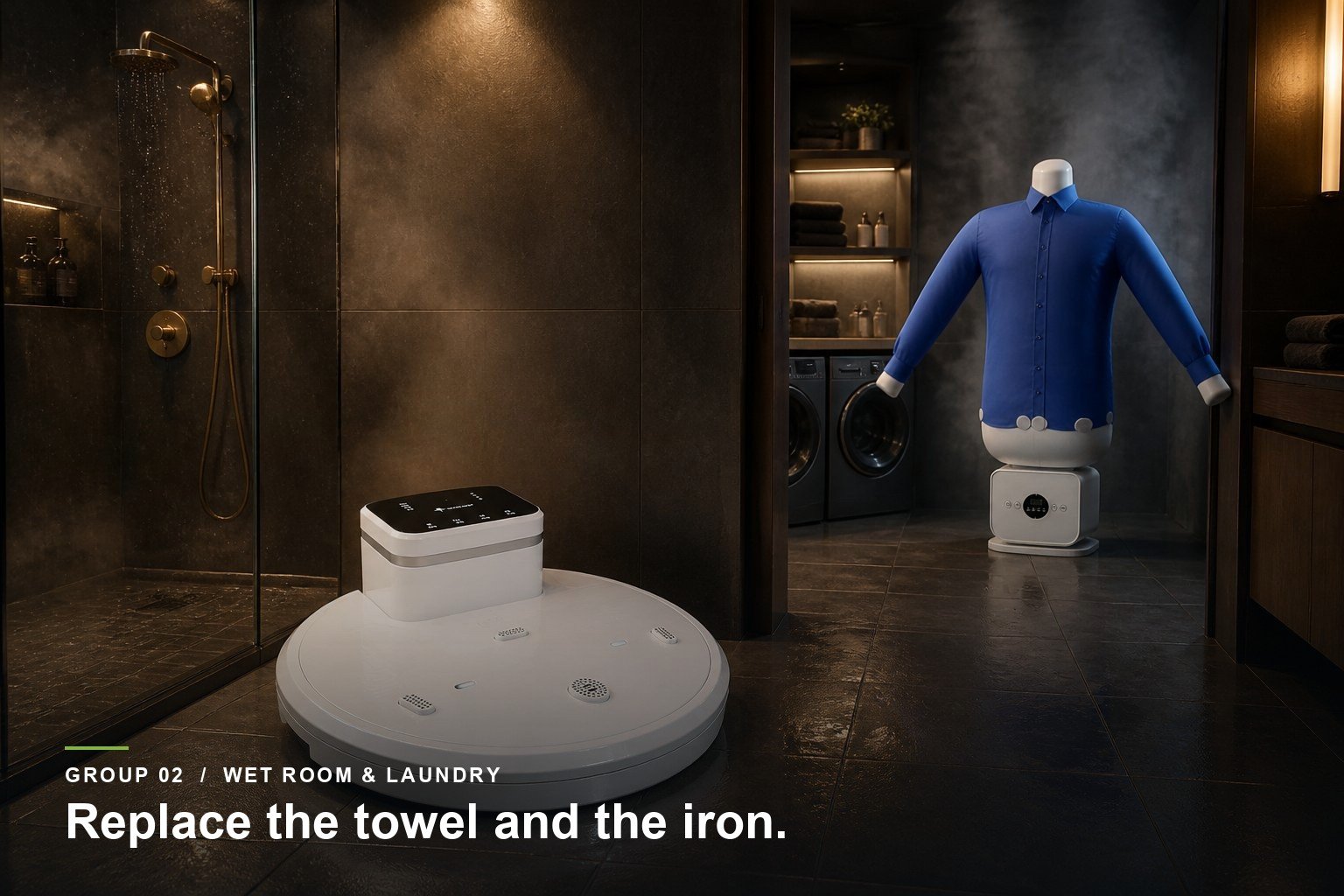
Hotel, resort, gym and pool facility procurement and engineering teams, spa and wellness centres, and the distributors who supply commercial laundry and housekeeping departments. These two units usually land in the same budget line, because both replace a manual step with a machine — the towel and the iron.
The constraint both models answer
Both sit in the wet half of a building, and both are judged on the same three numbers: what they draw, how long one cycle takes, and how many labour hours that cycle removes. Neither is a gadget purchase. A property that buys one of them is re-planning a shift.
AS-97 — negative-ion body dryer
A floor-standing unit that pushes warm or cool air at four speeds, leaving through a ring of outlets rather than a single nozzle, so the airflow covers the body instead of one point. The argument against towels is not comfort, it is the damp: a towel dries the skin and leaves the room wet, and a bathroom that stays wet is a bathroom that smells.
The build assumes a wet room. The body is IPX1 rated, the switch is a waterproof rocker, and there is a child lock — a unit standing in a pool changing room will be operated by people who have never read a manual.
- 2,500 W; four fan speeds; cool and warm air
- Touch panel with an LCD countdown, so a session ends on its own
- Temperature control and child lock
- 5 kg net with base, 7 kg gross
- Inner carton 49.5 × 20.5 × 52 cm; outer 53.5 × 22.5 × 54.5 cm, one unit
Full specification, packing data and product images: Molink AS-97 negative-ion body dryer
AS-89 — inflatable garment steaming mannequin
The garment is pulled over a deflated body, the body inflates until the fabric is taut, and 1,400 W of steam passes through from the inside. Collars, plackets and cuffs come out flat because the pressure is applied from behind the fabric instead of pressed onto the front of it.
The number that matters to a laundry is the cycle: a shirt straight from the spin dryer is normally finished in about ten minutes, and the unit runs continuously, so one machine keeps a small laundry moving through a whole shift. The timer runs 10 to 60 minutes.
- 1,400 W steam heating; inflatable mannequin body
- About 10 minutes per shirt from the spin dryer; continuous operation
- Timer 10–60 minutes
- Placed in hotel and guest-house laundry, dry-cleaning and shirt-service counters, garment factories and sample rooms, and uniform rooms in hospitals and restaurants
What to confirm before you order this group
- Circuit capacity at the installation point. 2,500 W and 1,400 W are single-unit loads, and a wet area may not be wired for either.
- Air and water. Drainage and ventilation around the AS-97; room ventilation around the AS-89, because it produces steam continuously.
- Fixed or mobile installation, and who services the unit on site.
- The AS-89 control type — mechanical or touch — is not fixed across production. Confirm which one you are quoting rather than assuming from a photograph.
Group 3 — Head and face care: AS-94 and AS-86

Who buys this group
Beauty salons and skin studios adding a head or face station to a treatment menu; personal-care, gift and hotel-amenity retail buyers; and private-label brands building a small-device line. This is the only group here where the same unit is sold both as a tool in a treatment room and as a boxed product on a shelf.
The constraint both models answer
Neither unit is bought to fill a room. Both are bought to fit a slot: fifteen to thirty minutes of a client’s time in a studio, or a price point and a box size on a shelf. That double life decides the design — cordless, compact, and finished well enough to be given as a gift.
AS-94 — air pressure head and eye massager
Four air chambers inflate around the temples, crown and brow in sequence, so the pressure moves rather than sitting on one point. Graphene heating runs across the eye area and holds a steady temperature — about 40 °C in roughly 20 seconds — instead of cycling hot and cold.
The detail that decides where it sells is the hinge. The shell folds to the size of a small case, which is what makes it a travel item rather than a bedside one, and it is why hotel rooms and corporate gifting sit on its use list next to the studio.
- Four air-pressure levels against forehead and temples
- Graphene heat to about 40 °C in roughly 20 seconds
- Bluetooth audio and hands-free calls
- Adjustable head width and height
- 1,800 mAh, rated 5 W, 1,095 g net
Full specification, packing data and product images: Molink AS-94 air pressure head and eye massager
AS-86 — cordless ultrasonic facial device
A cable decides how a device gets used: which side of the face you start on, and how long you stay there. This one runs on a built-in 1,200 mAh battery, so it is held like a tool rather than tethered like an instrument.
The head works at 1 MHz — the frequency normally used for skin work — and three intensity levels cover both a light facial routine and firmer work on the neck and shoulders. Duty cycle runs at 30, 40 and 50 percent, pulse width at 3, 4 or 5 ms, and the smart timer stops the cycle at 5, 10 or 20 minutes so a routine does not overrun. Overheat protection cuts the head if it runs without contact for too long.
- 1 MHz ultrasonic, ±10 percent; rated 4.8 W, maximum 9.6 W
- Three intensity levels at 30 / 40 / 50 percent duty cycle; pulse width 3 / 4 / 5 ms
- 12 V 1,200 mAh built-in battery; timer at 5 / 10 / 20 minutes
- Contact surface 39 ± 2 °C; 251 × 84 × 55 mm
- Supplied with a bottle of ultrasonic couplant — the head needs a medium to carry the wave into the skin
What to confirm before you order this group
- The package. Retail box, insert, manual language and plug type are what decide whether this sells on a shelf or only in a studio.
- Treatment menu or retail shelf — the accessory set differs, so state which one you are buying for.
- Consumables on the AS-86. The couplant is part of the routine; agree whether you stock it before you plan the shelf.
Group 4 — Industrial and outdoor walking assist: AS-85

Who buys this unit
Operations, safety and EHS managers in warehousing, manufacturing and facility services, plus the industrial safety distributors who supply them — and, on the other side of the same unit, outdoor and mobility retailers selling to walkers, hikers and older customers who want help over distance. Not spa buyers, and not a treatment-room product. The use cases on the specification run from warehouse picking and dock shifts, assembly and packing lines, field service and utility meter rounds and long patrol routes, to hill and trail walking, long day hikes and guided routes.
Why it stands alone in this list
The purchase logic is the opposite of the three groups above. A spa buys one unit for a room and measures it in sessions. An operation buys units per head and measures them in shift hours, battery swaps and injury risk. The unit is issued to a person, worn for eight hours, cleaned, and passed to the next shift. That is why this group has no companion model here: it is a different conversation with a different buyer, and presenting it beside a treatment-room product does neither any good. The one thing both buyers share is the drive itself: the same unit that carries a picker through an eight-hour shift carries a walker up a hill, because the assist is applied at the hip rather than at the knee.
What the unit does
Most powered walking devices put an actuator at the knee, which is why a new user needs training before they can climb stairs again. This one drives from the hip only: two brushless motors either side of the waist follow the wearer’s own gait, and the knee is left completely free. The control unit reads the start of each step and adds torque at the hip within 0.1 seconds. That is why it behaves the same on a dock and on a climb: the assist follows the wearer’s gait instead of imposing one, which is what keeps steps and rough ground under the wearer’s own control.
- 1.7 kg without the battery; six assist levels; IP54
- 5,000 mAh removable battery, 72 Wh; 3 to 5 hours per pack
- Passive knee link — no actuator and no lock, so stairs, ladders, kerbs and uneven ground stay with the body
- AI visual recognition and four modes
- 1-year warranty
Note what IP54 does and does not cover: splashing, not wash-down. A site that hoses equipment down needs a different routine, not a different rating.
What to confirm before you order
- Shift length and battery logistics. A removable 72 Wh pack is the unit of planning, not the device.
- The cleaning regime the site actually runs, not the one in the manual.
- Which setting the unit will actually meet. On a site it is a per-head tool, so the cleaning regime and the IP54 boundary — splashing, not wash-down — decide the routine. Sold for trail use, the same rating means rain and splashes are fine but a soaked pack is not, and the fit over thicker trousers matters more than it does on a warehouse floor.
- A trial protocol. This is a per-head purchase with a training step; agree the trial terms before the volume quote.
One note before ordering. These seven sit alongside the chair range rather than replacing it, and they load very differently: a chair, a floor-standing appliance and a boxed handheld device do not share a carton logic. If your first order mixes both, read how a mixed container is priced before you fix quantities.
Samples and first orders, by group
Samples ship before bulk orders across all seven models. What a sensible first order looks like differs by group:
| Group | What a first order usually is | What we need from you |
|---|---|---|
| 1. Treatment room | One AS-91 as a demonstration unit, or one AS-92 per operator | Destination voltage and plug, manual language, and the programme list for the AS-91 |
| 2. Wet room and laundry | One AS-97 or one AS-89, installed and measured against the manual step it replaces | Site power, drainage and ventilation, cleaning routine |
| 3. Head and face care | A small mixed lot for the shelf, or one unit per treatment station | Retail box artwork, manual language, whether couplant is stocked |
| 4. Walking assist | A trial unit per shift team before any volume quote | Shift length, cleaning regime, trial terms |
Related buyer guides: massage chair OEM and ODM programs · private label massage chairs · wholesale massage chairs
Private label runs across all seven: your logo on the unit, your artwork on the carton, your manual in your language. ODM work adds colour, panel graphics and accessories for the market you sell into. Minimum order quantities differ by model and are quoted per model — we do not publish a single number here that would be wrong for six of the seven.
Frequently asked questions about the new product line
Can these seven ship together in one container?
They can be combined, but they do not share a carton profile. The AS-91 ships as a single unit in an 820 × 740 × 1345 mm carton; the AS-97 ships one unit per inner and outer carton at 53.5 × 22.5 × 54.5 cm and 7 kg gross; the small devices pack several to a carton. Loading is calculated per model and per carton against your mix, and the resulting packing list is issued with the order. Anyone quoting you a container quantity before seeing the mix is guessing.
Are all seven available for private label?
Yes. Every model in this list can carry your logo on the unit, your artwork on the carton and a manual in your language. ODM work — colour, panel graphics, accessory set — is available on top of that and is quoted per model and per market. MOQ differs by model.
Do these carry the same certifications as the massage chairs?
Do not assume they do. Certification scope follows the model and the destination market, and a chair certificate does not automatically extend to a personal-care device, a bathroom appliance or a wearable. Ask for the report per model and per market before you print anything on a retail box, and check that the model number on the report matches the model you are ordering.
Which group is the right first order?
It depends on the channel, not on the price. A hotel buyer should start with group 2, because that is the budget line they already hold. A spa operator starts with group 1. A retail buyer tests group 3, where a mixed lot of boxed devices carries the least risk. Group 4 only makes sense once you have a shift team willing to trial it.
Is the AS-85 a medical device?
It is specified as a mobility and assisted-walking device for occupational and outdoor use: warehouse picking, assembly lines, field service and patrol on site, and walking, hiking and long routes outdoors. It is not presented here as a medical or rehabilitation product, and nothing in this article should be read as a clinical claim. Whether it is suitable for a clinical application is a decision for the buyer’s own clinical team and for local regulation in the destination market.
Can I order samples before a bulk order?
Yes, on every model. Give us the model, the destination voltage and plug type, and the manual language, and the sample ships ahead of production. Sample terms are quoted per model.
Related reading
- Inside the factory: how Molink builds and tests commercial massage equipment
- OEM or ODM: which route fits a new product line
- Private label: what changes and what stays ours
- Wholesale and mixed containers: what actually drives the unit price
- MOQ, pricing and container loading
- Certification and compliance checklist for importers
- Import duty and landed cost: what to confirm first
Next step. Tell us the group number and the model, plus your market and target quantity. We will come back with the full specification, the packing list and the lead time — not a generic catalogue. Write to sales@molinkpro.com or use the contact page.
One thought on “Seven New Products, Four Buying Groups: Who Each One Is For”